
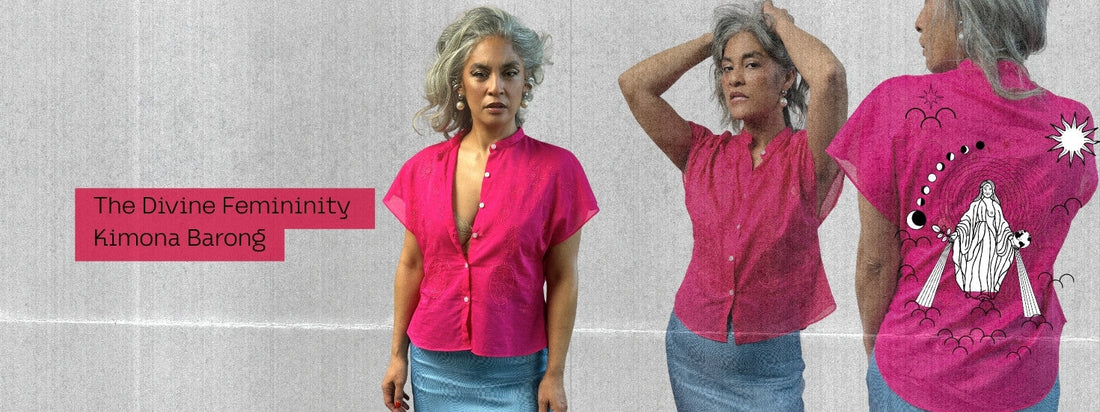
The Divine Feminine Kimona is a deliberate act of design and solidarity with the matriarchy: a garment that remembers who led long before history tried to make us forget. This piece is part of an atelier made in the Philippines collection—a Filipino-inspired, atelier-made women’s ready-to-wear collection inspired by Philippine Folk Culture—crafted with reverence for tradition and contemporary feminine expression.
This shirt was born as armor—soft armor. A quiet shield against harm, against negative energy, against the kind of bad spirits that don’t always have names. At the same time, it calls in what we actually deserve: healing, prosperity, liberation. Protection isn’t just about defense. It’s about illumination.
Historically, the symbols we inherit—especially in the Philippines—have been filtered through colonization and the masculinization of indigenous ritual. Power was reframed as male. Spiritual authority was dressed in a harder silhouette. So I took those symbols back. I tilted them. I revised them. I let them bloom. This is what happens when sacred iconography is allowed to breathe in a feminine body again, channeling Filipino heritage into every stitch.

Cut from semi-sheer cotton voile, the shirt floats. It’s light, fluid, quietly provocative. The sharp band collar and full button-down front keep it disciplined—clean lines. Continuous cap sleeves, drawn from the traditional Philippine kimona blouse, slice through with a subtle, reworked heritage edge. It nods to lineage without asking permission from it.
Front and back, the Divine Feminine motif is hand-manipulated and machine-embroidered—thread worked until it feels alive. It doesn’t sit on the fabric. It inhabits it. This isn’t decorative detail. It’s ancestral power stitched in. Indigenous-inspired imagery grounds the design in centuries of Filipino ritual and symbolism.

At the center of this concept is the anting-anting—also known as the agimat—the amulet that has historical manifestations as a full garment, carries magic, protection, and spiritual force. Philippine revolutionaries have worn these under their military uniforms. Around it, a living constellation of symbols drawn from diverse pre-colonial Philippine traditions: nature as teacher, ancestors as guides, the invisible world woven into daily labor, myth inseparable from survival. In these cosmologies, art, ritual, work, and life are one continuous act of becoming.
This shirt holds that memory. It’s not nostalgia. It’s reclamation.

Beyond Adornment: Decoding the Divine Feminine Kimona Barong
The Divine Feminine Kimona isn’t just a shirt—it’s armor woven with myth. Every embroidered symbol holds a story, a spark of power stitched into atelier-made women’s ready-to-wear pieces inspired by Philippine Folk Culture, echoing Filipino heritage and Filipino-inspired motifs.
- Araw – The Sun represents the higher self, symbolizing power, growth, health, passion, and the cycles of agrarian life in Filipino culture and religion.
- Makabuhay – Known as a universal medicine in the Philippines, it literally means “to give life.” It treats stomach ailments, indigestion, diarrhea, ulcers, and fevers and is reputed to have anti-malaria properties.
- Malunggay – Planting malunggay seedlings marks significant events, symbolizing miracles. Ancient Ayurvedic medicine claims its leaves prevent hundreds of diseases, and modern science confirms its remarkable nutritional value.
- Circle of Life – The pyramid with the all-seeing eye, as on the US dollar bill, has come to represent hierarchy and oppression. We replace it with circles inspired by matriarchy, emphasizing community, reciprocity, gift economy, regeneration, balance with nature, and love.
- Kalangitan – Clouds signify a transcendent space where gods, angels, spirits, saints, or ancestors originate, reflecting the spiritual cosmology of the Philippines.
- Kris at Hinating Bayag-Usa – Symbolizes resistance against Spanish rule while invoking liberation through dismantling patriarchy.
- Palaspas – Unopened coconut leaves with protective and healing properties, warding off evil and safeguarding homes.
- Bul’ol – Carved wooden figures from the Ifugao people, here depicted as female to embody unity with nature and ancestral spirit.
- Lingling-O – A round ornament symbolizing fertility, balance of masculine and feminine energies, and abundance.
- Infinitang Nagsasabog ng Biyaya – Embodies faith, humility, devotion, and purity, reconstructed as the Sovereign Woman, representing liberation and resistance to oppression.
Glossary of Terms
- Lakas ng Loob – Strength of inner self; courage, moral fortitude to face fear or difficulty.
- Pakikiramdam – Sensitivity to others; social intuition and the ability to “read the room.”
- Kagandahang Loob – Inner beauty; generosity and goodwill given freely.
- Kapwa – Shared identity; seeing others as fellow human beings, not separate.
- Pakikisama – Maintaining smooth relationships, harmony, and cooperation.
-
Pakikibaka – Struggle or resistance, often in pursuit of rights, survival, or justice.
These concepts are laid out as opposites as an invocation to deconstruct whatever is oppressive and to reconstruct whatever is liberating:
- Hiya / Walang Hiya – Hiya: shame, modesty, propriety. Walang hiya: shameless, lacking social propriety.
-
Utang na Loob / Walang Utang na Loob – Utang na loob: moral debt of gratitude. Walang utang na loob: ungrateful.
- Ibang Tao / Hindi Ibang Tao – Ibang tao: outsider; Hindi ibang tao: trusted, part of one’s inner circle.
This atelier made in the Philippines collection by REGALO Studios, steeped in Filipino heritage, Filipino-inspired design, and Indigenous craft, reflects the enduring wisdom, spirituality, and resilience of the Filipino people. Through sun, plants, sacred artifacts, and deities, these stories reclaim pre-colonial values, resist imposed hierarchies, and celebrate balance, protection, and communal life—botanical tones woven into the very fabric of an atelier-made women’s ready-to-wear collection inspired by Philippine Folk Culture.


